Peptides for Health in 2026: Benefits, Types, and New US Laws Making Them Easier to Access Than Ever
If you've been following the wellness world in 2026, you've probably heard the buzz around peptides. Once reserved for elite biohackers and anti-aging clinics, therapeutic peptides are now more accessible to everyday Americans than ever before — thanks to sweeping changes in US legislation and a growing body of scientific research validating their remarkable health benefits.
In this comprehensive guide, we break down exactly what peptides are, explore the science-backed health benefits driving their explosive popularity, and walk you through the recent regulatory shifts that have made peptides dramatically easier to obtain in the United States. Whether you're exploring peptide therapy for weight management, muscle recovery, gut health, or anti-aging, this post will give you everything you need to make an informed decision.
What Are Peptides?
Peptides are short chains of amino acids — typically between 2 and 50 — that act as signaling molecules in the body. Think of them as tiny messengers that tell your cells what to do. While proteins are also made of amino acids, peptides are smaller and often more targeted in their biological function.
Your body naturally produces hundreds of peptides that regulate everything from hormone production and immune response to inflammation and tissue repair. Therapeutic peptides — whether synthetic or bioidentical — are designed to mimic or enhance these natural processes, offering a precise and powerful approach to health optimization.
Unlike traditional pharmaceuticals that often cast a wide net, peptides tend to work with your body's existing biology rather than against it. That specificity is a major reason why peptide therapy has gained credibility across integrative medicine, sports recovery, endocrinology, and longevity science.
Top Health Benefits of Peptides
1. Weight Loss and Metabolic Support
Peptides like semaglutide (the active compound in Ozempic and Wegovy) and tirzepatide have transformed the weight loss landscape. These GLP-1 receptor agonist peptides work by regulating appetite, slowing gastric emptying, and improving insulin sensitivity. For anyone on the post-Ozempic journey, newer peptide options are providing exciting complementary and alternative pathways for sustained metabolic health.
Beyond GLP-1s, peptides such as tesamorelin and CJC-1295 support fat metabolism by stimulating growth hormone release, which helps reduce visceral fat while preserving lean muscle mass — a critical distinction from calorie-restriction-only diets.
2. Muscle Recovery and Athletic Performance
BPC-157 (Body Protection Compound) has become one of the most talked-about peptides in sports medicine. Research suggests it accelerates the healing of muscles, tendons, and ligaments by promoting angiogenesis (new blood vessel formation) and reducing inflammation at the injury site. Many athletes and active individuals use BPC-157 to bounce back faster from injuries and intense training.
TB-500 (Thymosin Beta-4) is another recovery-focused peptide that supports tissue repair, reduces scar tissue formation, and promotes flexibility in damaged muscles and joints.
3. Anti-Aging and Skin Health
Peptides are a cornerstone of modern anti-aging science. GHK-Cu (copper peptide) is widely studied for its ability to stimulate collagen production, improve skin elasticity, reduce fine lines, and even promote hair regrowth. Epithalon, a synthetic version of the naturally occurring peptide epithalamin, is being researched for its potential to activate telomerase — the enzyme responsible for maintaining the protective caps on your chromosomes — which could have far-reaching implications for cellular longevity.
4. Gut Health and Digestive Repair
For anyone dealing with gut issues — a common concern during and after GLP-1 therapy — BPC-157 is again a standout. Studies suggest it can help repair the gut lining, reduce symptoms of leaky gut syndrome, and calm intestinal inflammation. This makes it particularly relevant for readers navigating digestive changes while on or transitioning off medications like Ozempic.
5. Immune System Support
Thymosin Alpha-1 is a peptide that plays a critical role in immune regulation. It has been used clinically to support immune function in patients with chronic infections, autoimmune conditions, and even as an adjunct in certain cancer therapies. As immune health remains a top priority for Americans, this peptide is seeing renewed interest.
6. Cognitive Function and Neuroprotection
Peptides such as Selank and Semax have been studied for their nootropic effects — meaning they may enhance memory, focus, and mental clarity while reducing anxiety. These peptides modulate neurotransmitter activity and have shown neuroprotective properties in preclinical research, making them appealing to anyone looking to support long-term brain health.
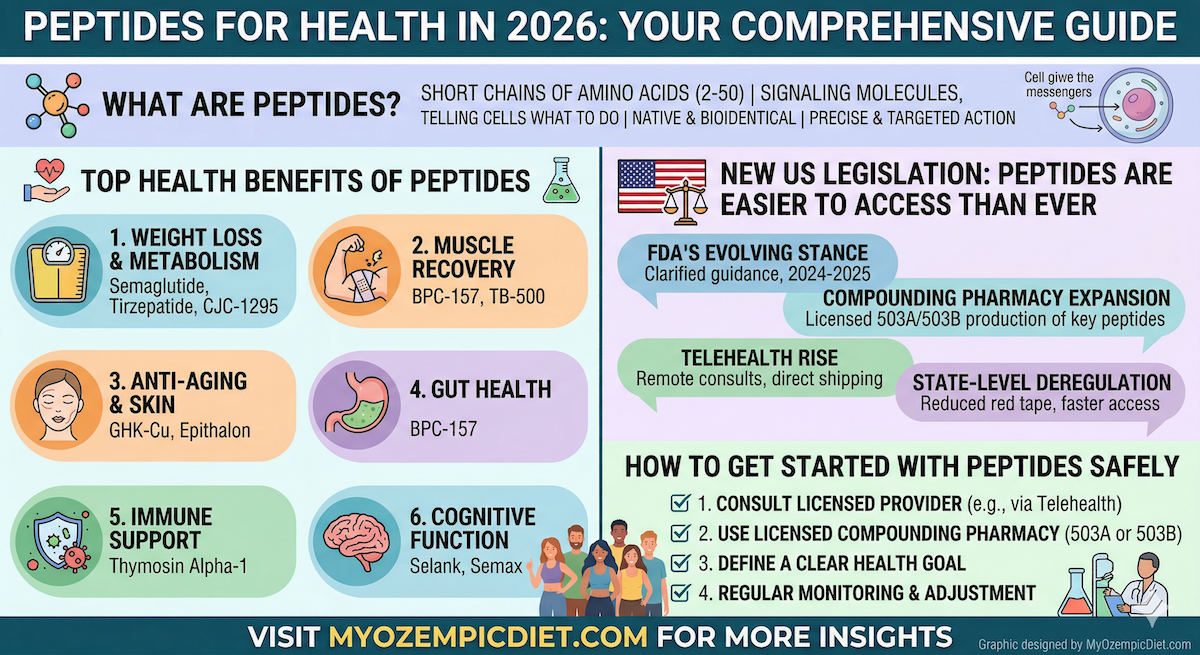
MyOzempicDiet has you covered on the top Peptides Health Benefits and how to get them!
New US Legislation: Why Peptides Are Easier to Access Than Ever
The regulatory landscape for peptides in the United States has shifted dramatically over the past two years, and 2026 marks a turning point for consumer accessibility.
The FDA's Evolving Stance
Historically, many therapeutic peptides existed in a regulatory gray area. Some were available through compounding pharmacies, while others were classified as research chemicals not intended for human use. The FDA's updated guidance in late 2024 and into 2025 began to clarify the pathway for compounding pharmacies to legally produce and distribute certain peptides, provided they meet quality and safety standards.
The Compounding Pharmacy Expansion
One of the biggest developments has been the expansion of 503A and 503B compounding pharmacy regulations. Under updated frameworks, licensed compounding pharmacies can now produce specific peptides — including BPC-157, thymosin alpha-1, and several growth-hormone-releasing peptides — for patients with valid prescriptions. This has removed a significant barrier that previously forced consumers to navigate unregulated gray-market suppliers.
Telehealth and Peptide Prescriptions
The rise of telehealth has been a game-changer for peptide accessibility. Patients can now consult with licensed healthcare providers from the comfort of their homes and, if clinically appropriate, receive prescriptions for peptide therapies that are shipped directly to their door. This model has exploded in popularity, particularly for weight-management peptides and recovery protocols.
State-Level Deregulation
Several US states have also passed legislation that further supports patient access to peptide therapies. These state-level actions have reduced red tape around prescribing and compounding, making it faster and more affordable for patients to begin peptide therapy under medical supervision.
The combined effect of federal guidance updates, compounding pharmacy expansion, telehealth normalization, and state-level deregulation means that in 2026, accessing peptide therapy is more straightforward, affordable, and medically supervised than at any point in history.
How to Get Started with Peptides Safely
If you're considering peptide therapy, here are the key steps to getting started the right way:
Work with a licensed provider. Always consult a qualified healthcare professional — ideally one experienced in peptide therapy or integrative medicine — before starting any peptide protocol. Telehealth platforms specializing in peptide prescriptions have made this easier than ever.
Use a licensed compounding pharmacy. Make sure your peptides are sourced from a 503A or 503B licensed compounding pharmacy. This ensures quality control, proper dosing, and regulatory compliance.
Start with a clear health goal. Peptides are highly targeted, so knowing what you want to achieve — whether it's fat loss, recovery, gut repair, or anti-aging — will help your provider recommend the right protocol.
Monitor and adjust. Peptide therapy is not a one-size-fits-all solution. Regular check-ins with your provider, along with bloodwork and symptom tracking, will ensure you get the best results safely.
The Bottom Line
Peptides represent one of the most exciting frontiers in health and wellness today. With robust scientific research supporting their benefits across weight management, recovery, anti-aging, gut health, immune support, and cognitive function — combined with new US legislation that has made them dramatically easier and safer to access — there has never been a better time to explore what peptide therapy can do for you.
If you're on your post-Ozempic journey or simply looking for the next science-backed tool to optimize your health, peptides deserve a serious look. As always, work with a trusted medical professional to build a protocol that fits your unique needs and goals.
Have questions about peptides or want to share your experience? Drop a comment below or reach out to us directly — we'd love to hear from you.
TL;DR — Peptides in 2026: What You Need to Know
Peptides are short chains of amino acids that act as targeted signaling molecules in the body. In 2026, they are one of the fastest-growing areas in health and wellness, backed by clinical research and now dramatically easier to access in the United States. Key benefits include weight loss and metabolic support (via GLP-1 peptides like semaglutide and tirzepatide), accelerated muscle and injury recovery (BPC-157, TB-500), anti-aging and skin rejuvenation (GHK-Cu, Epithalon), gut health repair, immune system regulation (Thymosin Alpha-1), and cognitive enhancement (Selank, Semax). Recent US regulatory changes — including expanded compounding pharmacy guidelines under FDA sections 503A and 503B, the growth of telehealth peptide prescriptions, and state-level deregulation — have made it safer, more affordable, and more convenient than ever to access peptide therapy with a valid prescription from a licensed provider.
Frequently Asked Questions About Peptides
What are peptides and how do they work? Peptides are short chains of 2 to 50 amino acids that function as signaling molecules in your body. They communicate with your cells to regulate processes like hormone production, immune response, tissue repair, and inflammation. Therapeutic peptides are designed to mimic or enhance these natural functions, offering targeted health benefits with fewer side effects than many traditional medications.
Are peptides legal in the United States? Yes. Many therapeutic peptides are legal in the US when obtained through a licensed healthcare provider and dispensed by a licensed compounding pharmacy operating under FDA sections 503A or 503B. Recent regulatory updates in 2024 and 2025 have further clarified and expanded the legal pathways for peptide prescribing and compounding.
What are the most popular peptides for weight loss? The most widely used peptides for weight loss are GLP-1 receptor agonists, including semaglutide (the active ingredient in Ozempic and Wegovy) and tirzepatide (Mounjaro and Zepbound). Other peptides such as tesamorelin and CJC-1295 support fat metabolism by stimulating natural growth hormone release, which helps reduce visceral fat while preserving lean muscle.
Can peptides help with recovery after injury? Yes. BPC-157 (Body Protection Compound) is one of the most researched peptides for recovery. Studies suggest it promotes healing of muscles, tendons, and ligaments by stimulating new blood vessel formation and reducing inflammation. TB-500 (Thymosin Beta-4) is another peptide commonly used to support tissue repair and reduce scar tissue.
What peptides are best for anti-aging? GHK-Cu (copper peptide) is one of the most studied anti-aging peptides. Research indicates it stimulates collagen production, improves skin elasticity, reduces wrinkles, and may promote hair regrowth. Epithalon is another peptide being researched for its potential to activate telomerase, an enzyme linked to cellular longevity.
Do I need a prescription for peptides? For most therapeutic peptides, yes. A licensed healthcare provider must evaluate your health goals and medical history before prescribing peptide therapy. The good news is that telehealth platforms now make it easy to consult with a peptide-experienced provider remotely and have your prescription shipped directly to your home.
Are peptides safe? When prescribed by a qualified provider and sourced from a licensed compounding pharmacy, peptides have a strong safety profile. Because they work with your body's natural biology, side effects tend to be mild compared to many conventional drugs. However, like any therapy, peptides should be used under medical supervision with regular monitoring.
How do peptides relate to Ozempic and GLP-1 medications? Semaglutide — the active compound in Ozempic and Wegovy — is itself a peptide. The broader peptide therapy space offers complementary options for people on their post-Ozempic journey, including peptides that support gut repair, muscle preservation, metabolic function, and overall recovery during and after GLP-1 treatment.
How can I start peptide therapy in 2026? The easiest way to get started is to consult with a licensed healthcare provider who specializes in peptide therapy or integrative medicine. Many telehealth platforms now offer virtual peptide consultations. Once prescribed, your peptides will be prepared by a licensed compounding pharmacy and shipped to you. Always verify that your pharmacy is 503A or 503B licensed for quality assurance.
Sources & References
U.S. Food & Drug Administration (FDA) — Compounding and the FDA: Questions and Answers https://www.fda.gov/drugs/human-drug-compounding/compounding-and-fda-questions-and-answers
National Institutes of Health (NIH) — Therapeutic Peptides: Current Applications and Future Directions https://www.ncbi.nlm.nih.gov/pmc/articles/PMC7400044/
PubMed / National Library of Medicine — BPC-157: A Review of Its Biological Actions and Potential Therapeutic Applications https://pubmed.ncbi.nlm.nih.gov/32585237/
New England Journal of Medicine (NEJM) — Semaglutide and Cardiovascular Outcomes in Obesity https://www.nejm.org/doi/full/10.1056/NEJMoa2032183
Mayo Clinic — Peptide Therapy: What You Need to Know https://www.mayoclinic.org/healthy-lifestyle/consumer-health
National Institutes of Health (NIH) — GHK-Cu Peptide: Biological Activity and Mechanisms of Action https://www.ncbi.nlm.nih.gov/pmc/articles/PMC6073405/
U.S. FDA — Section 503A and 503B of the Federal Food, Drug, and Cosmetic Act https://www.fda.gov/drugs/human-drug-compounding/pharmacy-compounding-policy-documents
Cleveland Clinic — GLP-1 Receptor Agonists: What They Are and How They Work https://my.clevelandclinic.org/health/treatments/glp1-receptor-agonists
Harvard Health Publishing — The Science Behind Peptides and Aging https://www.health.harvard.edu
World Health Organization (WHO) — Biological and Biotechnological Medicines https://www.who.int/health-topics/biologicals